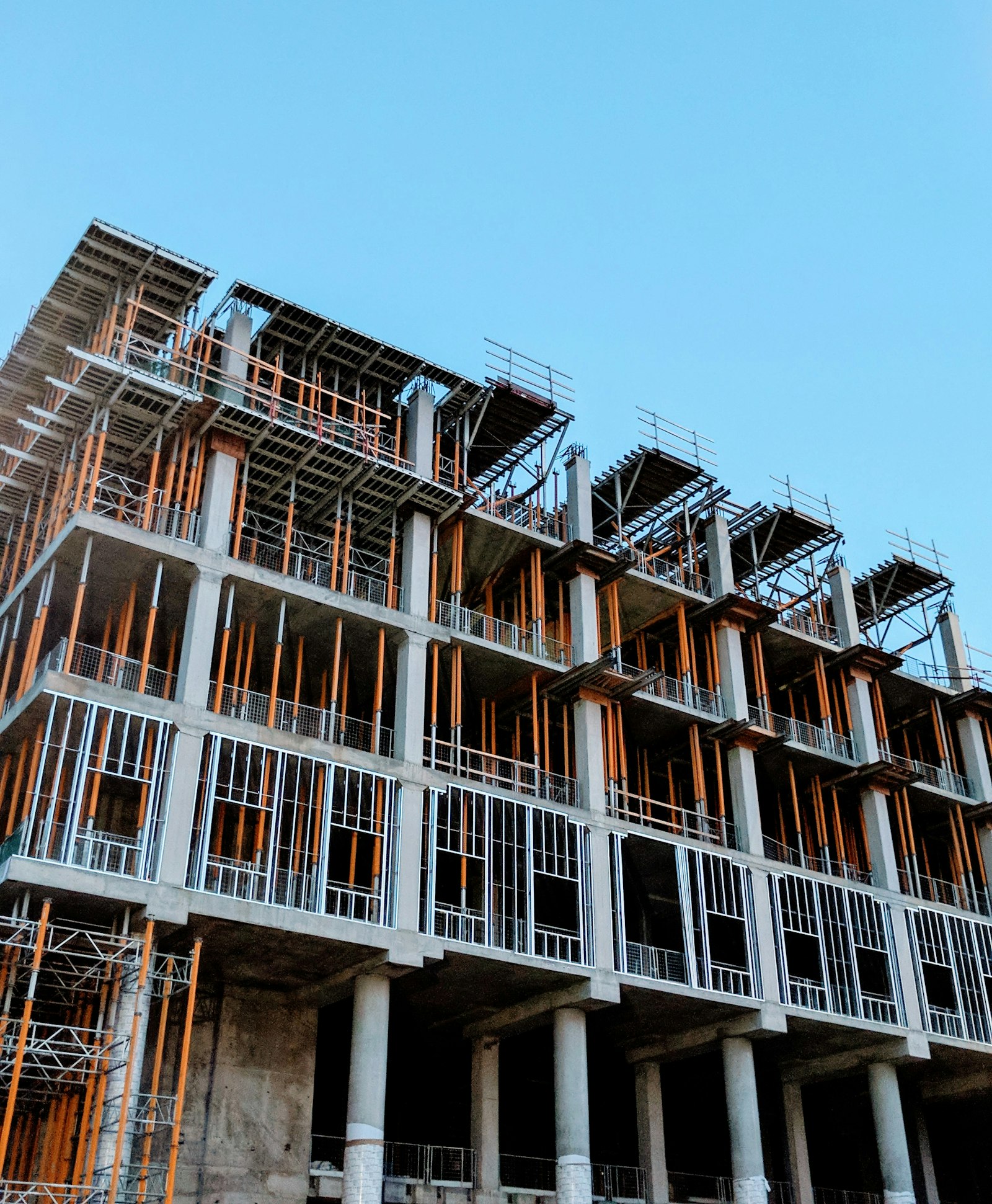
What is a post-tensioned slab
In conventional reinforced concrete, you pour concrete around steel bars. The steel resists tension; the concrete resists compression. It works — but the slab is heavy, and spans are limited.
In a post-tensioned (PT) slab, high-strength steel strands run through plastic sheaths inside the slab. After the concrete cures, hydraulic jacks pull (tension) those strands to around 75% of their yield strength. The strands are anchored at the ends, and the tension is transferred into the concrete as compression. The slab is now pre-compressed — it can span further, deflect less, and use less material to do the same job.
The technology is not new. What is new is the speed at which it is spreading into Indian residential and small commercial projects.
Why builders are switching
1. Longer spans, fewer columns
A conventional RCC slab in India typically spans 5–6 metres between columns. A PT slab comfortably spans 9–10 metres, and 12 metres is not exotic. For a building owner, that means fewer columns in the parking basement, more flexibility in apartment layouts, and larger column-free living rooms.
2. Thinner slabs
A PT slab is typically 25–30% thinner than an equivalent RCC slab for the same loading. In a 20-floor building, that adds up to more than one full floor of extra height within the same envelope — directly valuable in floor-space-limited Chennai plots.
3. Less material
Because the slab is thinner and uses less conventional rebar, total concrete and steel consumption drops by 15–25%. The carbon footprint drops with it.
4. Less cracking, less long-term deflection
Pre-compressed concrete cracks far less under service loads. That means better floor finishes, fewer tile failures, and tighter tolerances for level floors — critical in commercial fit-outs.
Where it makes sense
- Mid- to high-rise residential (G+8 and above) where thin slabs win floor height and column-free apartment layouts win sale value.
- Commercial and office buildings where tenants need open floor plates.
- Large parking basements where fewer columns mean more parking spaces and easier manoeuvring.
- Premium villas with 8m+ spans — rare but growing, especially for large living-and-dining volumes.
Where it does not
- Small residential (G+2, G+3). The specialist labour, the stressing jack on site, and the design cost don’t pay back on small spans.
- Heavily renovated buildings. Drilling into a PT slab without knowing where the tendons run is genuinely dangerous. Any future retrofit needs the original tendon layout drawings.
- Tight budget projects. The direct cost is 10–15% higher per square foot of slab. The payback comes through the other wins listed above — if those wins don’t matter to you, the economics don’t work.
The risks nobody tells you about
- Corrosion of tendons. If the plastic sheathing is damaged or the grouting is incomplete, tendons corrode invisibly and fail suddenly. Every PT project needs a supervised grouting protocol and end-anchor inspection.
- Repair is specialist-only. Chipping into a PT slab without a scan is how people die. The owner’s as-built drawings need to show tendon layouts clearly and permanently.
- Fewer firms know how to design it well. The number of structural engineers in Tamil Nadu comfortable with post-tensioning is still small. Picking the wrong designer is a bigger risk than picking the wrong builder.
What to ask
- “Who is the PT specialist designer, and how many residential PT slabs have they completed?”
- “What grouting specification are you using, and is it supervised?”
- “Will the as-built tendon layout be delivered in both PDF and BIM format?”
- “What is the slab deflection projected at 10 years under service load?”
Where this goes next
As Chennai continues to grow vertical, and as column-free apartment layouts become a sales differentiator, PT slabs will keep moving from premium commercial into mainstream residential. We expect 30–40% of new high-rise residential projects in Chennai to use post-tensioning by 2028.
If you are weighing conventional RCC against PT for a project and want a straight comparison of cost and lifecycle, we are happy to run the numbers for your plot.